From Our Archives
For earlier essays on this week’s RCL texts, see Dan Clendenin, Peace to You (2023); Debie Thomas, I Will Pour Out My Spirit (2020); Ricardo Avila, Pentecostal Praise (2017); and Dan Clendenin, From the Inspiration of the Spirit to the Institution of the Church (2011).
This Week's Essay
By Amy Frykholm, who writes the lectionary essay every week for JWJ.
Acts 2:18: “In those days I will pour out my Spirit.”
For Sunday May 24, 2026
Lectionary Readings (Revised Common Lectionary, Year A)
Psalm 104:24–34, 35b
1 Corinthians 12:3b–13 or Acts 2:1v21
John 20:19–23 or John 7:37–39
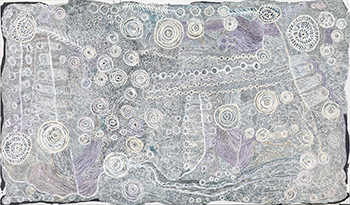
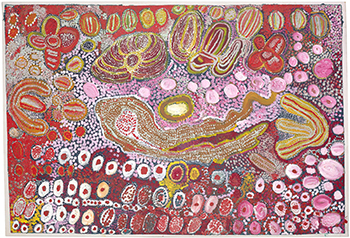
Betty Muffler is an Australian Indigenous artist and traditional healer. In her painting “Ngangkari Ngura (Healing Country),” the country she references is rendered much like an abstract landscape painting. The landscape is evoked by symbols, stars, circles, dots, and a backdrop intricately woven like a blanket. Muffler created this painting through a process that her culture calls Dreamtime.
Dreamtime is a difficult process for a non-Indigenous person to understand, and I do not pretend to. It is worth noting that the phrase itself comes from a British anthropologist who was trying to translate into English untranslatable concepts from Indigenous languages. It is the roughest of a rough approximation.
That said, Dreamtime involves communication with the ancestors, with their creative journeys and their evocation of a specific landscape — only parts of which are visible to the human eye. Other aspects are represented by the artist who seeks to render them as a kind of spirit-map of a physical country.
In “Ngangkari Ngura,” Muffler evokes her image by connecting to the spirit of an eagle. She sees ridges and water holes from the eagle’s point of view. As a child, Muffler was forcibly removed from her home. British nuclear testing took place on her homeland, spread sickness throughout the community, and killed family members. In the spirit of this experience she uses Dreamtime painting to seek healing.
Despite the deeply personal nature of Muffler’s story, these maps are not intended as individual expression or even an account of a spiritual journey taken by the artist. They are communal documents. The artist is a messenger in communication with other messengers. And the paintings are meant to offer instruction, received from spiritual sources, for the benefit and nourishment of the people.
 |
|
Betty Muffler, Ngankari Ngura (Healing Country) (2022).
|
The result is not only breathtakingly beautiful, it is also a teaching document. In the paintings, you can see paths taken by ancestors as well as animal guides. You can observe where the people found water, where they set up encampments, but also where they received visions and previous instruction. The maps defy the distinction in European art between abstract and representational art. They are both at the same time. The maps also connect human life to spiritual life and to cosmic life — they evoke water, stars, and other celestial beings with the inner lives of humans in one interconnected tapestry.
These maps not only reveal interconnectedness, they also make something new out of something old. They are not stories about the past so much as a way of connecting the past with the present and showing the people how to live in the present. They reveal “timeless time,” the ever ongoing, unfolding nature of reality.
In Acts 2, Peter tells us that the purpose and meaning of Pentecost is, like Muffler’s painting, both interconnectedness and healing. In that day, he says, the interconnectedness of all people with the spiritual realms will be revealed. He quotes from the prophet Joel’s vision of spiritual outpouring, “I will rain down my Spirit upon all human beings from every nation” (Acts 2:17; Joel 2:28).
We might remember here that when we enter Acts 2, despite its seeming naïveté about culture and how culture shapes meaning, we are in fact entering a culture that is foreign to us. The Dream begins as the people gather for the Festival of the First Fruits. They’ve brought with them the bikkurim — the first fruits of the harvest—with the intention of giving thanks at the Temple for these hints of providence. The festival links the Israelites’ flight out of Egypt with renewal in the land of Israel in a cycle of thanksgiving. Seven plants were included, considered to be the fundamental plants of their culture: wheat, barley, grapes, figs, pomegranates, olives, and dates.
The first-fruits festival was a recognition that the earth is always being renewed in ancient cycles of death and regeneration — a timeless time. “Behold, I make all things new” (Revelation 21:5) can perhaps be understood as a statement of both linear and cyclical time, each kind of time providing a different emphasis.
 |
|
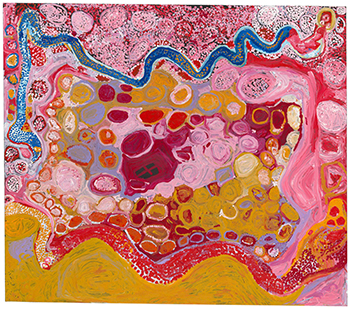
Tiger Palpatja, Wati Wanampi Tjukurpa (2010).
|
During this festival, people gathered from all over the known world to present the bikkurim at the Temple. They would assemble into a procession outside the gates and then enter together. As they walked through the gates of the city, the people would declare, “Our feet were standing in your gates, O Jerusalem.” Then the people of Jerusalem would greet them: “Our brothers and sisters, you have come in peace.”
Acts 2 tells us that during this festival of renewal, 120 followers of Jesus experienced a collective dream: something new out of something old. “A great windstorm from the spirit world above … could be heard throughout the house where they were sitting” (Acts 2:2, First Nations Version). Flames came down and rested on their heads. They began to speak in new languages. Whatever was happening, there was enough noise that a crowd began to gather and to observe.
The passage never tells us about the experience from the followers’ point of view. What was it like to have a flame on one’s head and start spouting another language? Did they feel empowered? Bewildered? Excited?
Instead the perspective shifts to the witnesses. As you might expect, the crowd’s interpretation of events varies from amazement to skepticism. Peter has the unenviable task of trying to explain to them what he himself probably does not yet fully understand. His ability to begin preaching in the midst of these events raises a lot of questions for me. Is this experience happening to Peter? And if it is happening to him, is he being heard in each person’s native language? Or is he speaking Greek, the lingua franca of those gathered, or Aramaic, probably his own native language?
He begins his interpretive task by emphasizing a common ancestor among those who are gathered: the prophet Joel. This is the promised outpouring of the Spirit, he says. When the Spirit rains down, “your sons and your daughters will prophesy. Young warriors will see visions and elders will have dreams” (Acts 2:17, First Nations Version). This will be done so that the people can be “made whole and set free” (Acts 2:21). He points to the resurrection of Jesus as a sign of this reality.
 |
|
Wingu Tingima, Minyma Tjuta (Seven Sisters) (2006).
|
We know, from reading the rest of Acts, that this moment of potential understanding and unification is quite temporary. The apostles are imprisoned, beaten, and stoned as they try to bring this message to the world. We also know that they set out for remote destinations, sharing their message of interconnectedness and healing with a wider world. They no doubt discovered again and again that new contexts create new meanings and new understandings.
Two millennia later, we know we cannot live in Pentecost. Even recovering the old meanings of these events is impossible. We might crave this kind of experience. We might even try to manufacture it or manipulate it. But a better question might be: how can we let Pentecost inform and transform our ordinary practice?
One answer that we might learn from our Indigenous neighbors is to stay connected to the Dreamtime. Seek to grow in the capacity to have the spiritual ears to hear and eyes to see. In Open Mind, Open Heart, Thomas Keating writes, “Our awakening to the presence and action of the Spirit is the unfolding of Christ’s resurrection in us.” This is a profound mystery, simultaneously a collective vision and a practical means for living — full of paradoxes of dreaming and waking, ancient and new, past and present. With the Spirit, we seek continual inspiration to live more fully into the resurrection. Catholic priest, Father Edward Dowling, who helped Bill Wilson found Alcoholics Anonymous, often said, “Sometimes I think heaven is just another pair of glasses.” That’s probably true of Pentecost as well. Perhaps it is just a way of awakening a deeper sense of sight.
Weekly Prayer
Manny Loley
night drapes
stars emit light
around the north star-fire
stars journey
in their wake
stories extendTranslated from the Diné by the author.
Manny Loley is a Diné poet and storyteller. He holds a Ph.D. in English and Literary Arts from the University of Denver. He also served as the director of the Emerging Diné Writers' Institute. This poem was published in Poetry in March 2025.
Amy Frykholm: amy@journeywithjesus.net
Image credits: (1) National Gallery of Victoria, Australia; (2) Denver Art Museum; and (3) Denver Art Museum.