From Our Archives
For earlier essays on this week's RCL texts, see Dan Clendenin, Miracles and the Mundane (2023); Debie Thomas, I Am the Gate (2020); and Dan Clendenin, Life Together (2017) and Slaves, Submit to Your Masters (2011).
This Week's Essay
By Amy Frykholm, who writes the lectionary essay every week for JWJ.
John 10:10: “I came that they might have life and have it abundantly."
For Sunday April 26, 2026
Lectionary Readings (Revised Common Lectionary, Year A)
Psalm 23
1 Peter 2:19–25
John 10:1–10
We were vacationing in Wales on a narrowboat, motoring slowly along the Monmouthshire and Brecon Canal. Our seven year-old son had spent the week becoming acquainted with and even falling in love with the local sheep. He’d already announced his intention to become a shepherd.
On our last evening, we tied up alongside an ancient aqueduct that towered over the River Usk. In the morning we planned to return the boat, catch a train to London, and head home. My husband went to take some pictures of the famous aqueduct from below, and ended up walking along the river bank. At one point he looked down, and there he saw a lamb trapped in the river — at the bottom of a steep, slick, mud chute — struggling futilely to climb its way out. Its head and shoulders were above water, but its body was weighed down by the heft of a dozen wet sweaters. He ran up the hillside to the canal, and alerted other boaters. “You’re in luck,” one of the boaters chuckled, “the gentleman in the next boat used to be a shepherd!”
With a willingness that fell a bit short of enthusiasm, the man grabbed a few ropes and a big canvas bag, and together with our inexpert troop headed down to the river bank on a rescue mission. The retired shepherd, Anton, threaded a rope loosely around the sheep’s neck so that it wouldn’t be swept downstream, then waded into the water and hauled the sheep up with graceful muscularity. For the next 20 minutes, we helped Anton wring as much water as we could out of the lamb’s wool. He feared that the lamb could die from internal stress or hypothermia, even though it was now safely on land, and he hinted that the end could be very near. When we’d wrung what water we could out of the lamb’s wool, Anton carried it further up into an open meadow, so that it was within visual range of the flock.
 |
|
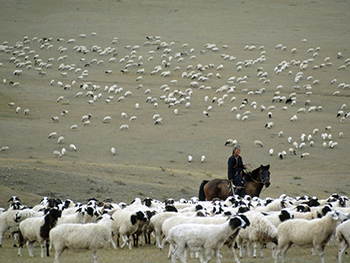
Dean Conger, Herding Sheep.
|
Anton returned to his boat, but we stayed behind to observe, largely on the insistence of our son. Near the edge of the flock, perhaps 200 feet away, a sheep bleated incessantly and stared in our direction. Anton had guessed this was probably the lamb’s mother and thought the chances of reintegration were good. But when we left the lamb and the flock at dusk, no reunion had yet taken place. In the morning, there was no sign of lamb, sheep, or flock.
We were thrilled by our sheep adventure. We’d never been so close to an animal rescue before and felt a bit proud of the role we (my husband anyway) had played. The next day when we returned our canal boat to the marina, we excitedly recounted the tale to the owner. She sighed. “I can’t tell you how often my husband says, ‘Well, I’m off to save a sheep.’ Stupid, stupid creatures.”
I can’t really read scripture about shepherds and sheep without recalling this adventure in Wales with the sheep. What struck me perhaps most was the combination of adventure with the utterly quotidian nature of the sheep rescue. My take-away message was: sheep always need rescue.
So when I read, as in 1 Peter 2:25, “You were going astray like sheep,” I think of that helpless creature, hemmed in on all sides by downed trees that were clogging the river bank. I think of how mindlessly it wandered into trouble. The sheep was just doing what it always does. It was grazing with its herd. One minute, life was normal — green pastures, rolling waters — and the next minute, the peril was so great the sheep might be swept away. And whatever happened following the rescue, the herd returned to exactly the same daily practice, with exactly the same perils.
 |
|
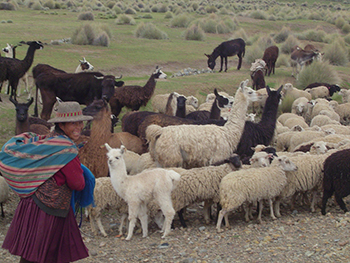
Dean Conger, Herding Sheep.
|
The word quotidian, Kathleen Norris observes in her book The Quotidian Mysteries, is a combination of two roots. Dies means “shining one,” the day, and also closely related, deus, God—linked in their Indo-European root. And quot refers to quantity. The word quotidian is thus essentially a question: how many days? Imbedded in its origins is an implicit acknowledgment of those days — whatever their quantity — as sacred.
In some of the scriptures that compare human lives to sheep and shepherd, there is a beautiful idealization of shepherding. How many of us have not rested for at least a moment in the lines of Psalm 23, “The Lord is my shepherd; I shall not want”? But we also live in the reality that there are perils everywhere. It’s remarkable that during the Easter season, as we attempt to understand the meaning and purpose of the remarkable event of the Resurrection, the scriptures return us to this more quotidian meaning and purpose.
In a recent article in the New York Times, P.G. Sitterfield writes about discovering the quotidian nature of both death and resurrection while in prison for fraud. He found that parts of himself had to die so that his life could be saved and he could be resurrected. He writes, “The part of me that cared a lot about winning and rising — and about doing so quickly — had to die so I could fully inhabit the part of me that cared most about serving.” Meanwhile, all around him, as he listened to his fellow inmates, he heard stories of redemption and healing. “Imprisonment, defeat and death might get their say, but they do not get the last word.”
 |
|
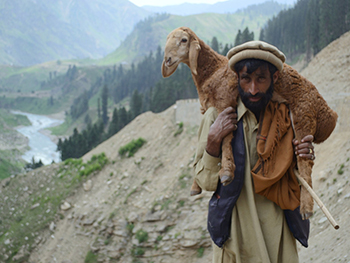
Zahra Atiq, Shepherd.
|
Acts 1 recounts the extraordinary moments of Jesus’ ascension. The beginning of Acts 2 tells of the fiery events of the Pentecost, but by the end of the chapter, it seems like the question of “so now what?” has already arisen. In verse 42, the disciples are focused on ordinary acts of kindness and connection as they attempt to discern how to live in the light of the Resurrection. They study, pray, and break bread. They share their possessions and live “day by day.” The “signs and wonders” are now so ordinary, no specifics are offered.
We also live in extraordinary times. All around us we feel the pain and suffering of the world and walk through our own valleys. We don’t know what will happen tomorrow. It is difficult to stay focused on today’s questions in the midst of war, climate change, natural disasters, and despair.
This week’s scriptures turn our attention back to the realm of the mundane: sheep rescues and other ordinary joys. Gregory of Nyssa writes, “Let us remember that the life in which we ought to be interested is ‘daily’ life. We can, each of us, only call the present time our own. Our Lord tells us to pray for today, and so he prevents us from tormenting ourselves about tomorrow. It is as if [God] were to say to us: [It is I] who gives you this day [and] will also give you what you need for this day. [It is I] who makes the sun to rise. [It is I] who scatters the darkness of night and reveals to you the rays of the sun.”
Weekly Prayer
Celtic Blessing
God to enfold me,
God to surround me,
God in my speaking,
God in my thinking.God in my sleeping,
God in my waking,
God in my watching,
God in my hoping.God in my life,
God in my lips,
God in my soul,
God in my heart.God in my sufficing,
God in my slumber,
God in mine ever-living soul,
God in mine eternity.Originally from the Carmina Gadelica III, 53, this version was taken from Esther de Waal, editor, The Celtic Vision (Triumph, 2001), p.20.
Amy Frykholm: amy@journeywithjesus.net
Image credits: (1–3) National Geographic.