From Our Archives
For earlier essays on this week's RCL texts, see Debie Thomas, Let Not Your Heart Be Troubled (2023); Dan Clendenin, The Stoning of Stephen (2014) and The Stone of Stumbling: 10 Reflections on Christianity and World Religions (2011).
This Week's Essay
By Amy Frykholm, who writes the lectionary essay every week for JWJ.
John 14:5: “Lord, we do not know where you are going. How can we know the way?”
For Sunday May 3, 2026
Lectionary Readings (Revised Common Lectionary, Year A)
Psalm 31:1–5, 15–16
1 Peter 2:2–10
John 14:1–14
One day in the summer of 2019, three members of my church gathered in the sanctuary to do a major cleaning. Members isn’t even the right word — it had been a long time since we’d had “members” in the way that traditional churches have them. We had participants, people who showed up for various things and in various ways.
Our priest had recently fallen ill with stage three ovarian cancer and had taken medical leave. She was, at that moment, living in the home of a friend and slowly weaning off of a feeding tube that had been providing her nourishment for months.
It was a dark moment for our congregation. In the course of a year, we would lose not only our priest (who survived the cancer and moved away), but about 75% of the people who were regular participants in church life. People moved, died, or simply dropped out.
In the midst of all of this uncertainty and loss, with no real future in sight, we took random pieces of furniture that had been sitting idle in dusty corners to the curb. We packed up boxes to give away or carry to the basement. The whole time I had a sense of an ending. A chapter of the life of this 145 year-old building was over. What form would the church take next, I wondered. Who were we doing this cleaning for? I tried to envision a future congregation in which I didn’t even include myself.
 |
|
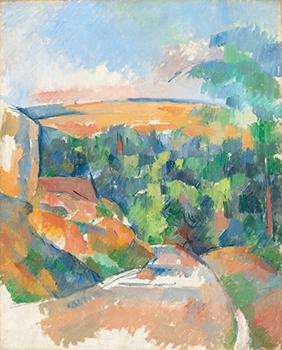
Paul Cezanne, The Bend in the Road (1900/1906).
|
The answer came in the most unexpected way: a global pandemic. As it turned out, what we ended up clearing that space for was a large food pantry, built in the wake of COVID-19. For decades our church had hosted several community meals a week and a monthly food pantry. We were known as “the food church.” But in the first few weeks of COVID, the health department let us know that we couldn’t host in-person meals. We didn’t know how to meet the moment.
But from both inside and outside the immediate church community, a food pantry emerged from the ashes. We arranged it on folding tables in the newly cleaned out sanctuary, grocery-store style. One participant knew that grants were available from the state of Colorado for food pantries; another researched COVID-safe protocols. Pretty soon we were seeing 100 people a day and delivering another 125 food boxes to people’s homes with the help of more than 150 volunteers.
From our human perspective, all of this seemed shaky. For the first several months we lived week to week. We’d say to each other, well, we have enough funding for another two weeks. Then, who knows? Two weeks later, we’d say the say same thing, and so on. We constantly interrogated our health protocols. With so many other food pantries closing, we wondered if we were wrong to be holding an in-person pantry, even with all the precautions we put in place.
 |
|
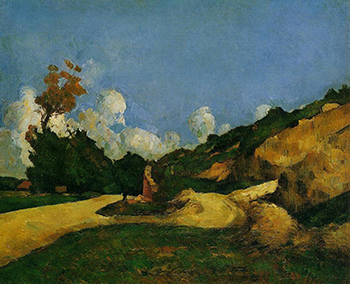
Paul Cezanne, Road (1871).
|
There was so much going on and so many moving pieces that when members of the remnant asked each other how all of this was happening, we shrugged and laughed. “Must be the Holy Spirit.”
Because, truth be told, something did feel both holy and spiritual about those chaotic days. Every day we learned something more about who we were and what we were capable of. Every day we welcomed someone new in the doors, whether it was a new volunteer or a new food pantry shopper — and not infrequently both in the same person. And we didn’t always know what needs we were meeting, even as we were meeting them. One day, when I was at the church preparing a to-go lunch for pantry participants, a woman called and asked if we had any fresh tomatoes. When I said we did, she started crying. Another woman told me that she was using the food pantry to teach herself how to cook for the first time in her life. She’d made chicken tacos and driven them down to visit her estranged son in a town not far away. They’d eaten outside at a picnic table.
“Lord,” Thomas says in John 14, “we do not know where you are going. How can we know the way?” Jesus answers, “I am the way.”
 |
|
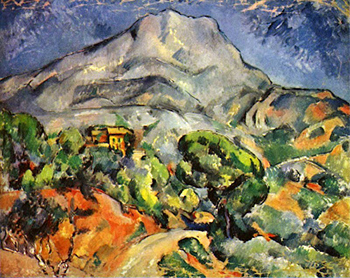
Paul Cezanne, Road Before the Mountain Sainte-Victoire (1898–1902)
|
What does Jesus mean by that? Maybe Jesus means that there may not always be a sure destination, but there will be food for the journey. Maybe Jesus means that we have to stay focused on that journey and rely on the love, creativity, and spontaneity of the moment instead of on our certainties about how this is supposed to go. Maybe Jesus means that endings are beginnings, and that doors open where you cannot anticipate them. That the abundant life we think we are missing is right in front of our eyes.
Episcopal priest Becca Stevens writes, “Community, love, and grace are the most powerful forces of individual and social change.” The Magdalene community that she started in Nashville, Tennessee for women coming out of jail taught her to “try fearlessly because the only thing we need to fear is not being able to love at all.” The way, Stevens writes, has no shortcuts. The journey is “slow and miraculous and our job is just to keep going, respecting love’s power.”
So we set out. We try. We experiment. We wonder. We trust love’s power and love’s guidance. With Thomas, we ask, “How can we know the way?” And then we put our feet on the path, with no outcomes guaranteed except love.
Weekly Prayer
Becca Stevens (b.1963)
Before the sun rose
Or an altar was hewn
Before the crocus bloomed
Or a winter passedBefore the birds sang
Or the seas parted
Before a word was spoken
Or an apple bittenBefore the wine was blessed
Or a cross lifted
Before the path was chosen
Or a prayer offeredThere was sanctuary.
Becca Stevens (b.1963) is an Episcopal priest in Nashville, Tennessee who founded Thistle Farms, a global organization that supports women’s entrepreneurship. She also founded Magdalene House, a two-year residential program for former prostitutes overcoming addiction and wanting to restart their lives. This poem is from Sanctuary (Dimensions for Living, 2005), p.13.
Amy Frykholm: amy@journeywithjesus.net
Image credits: (1) National Gallery of Art; (2) Artchive; and (3) Marcelo Guimarães, Lima.